When Ties are Torn | QUILTS of COMMUNITY
It was a time of pandemics and moral panic.
Culture wars at home and military conflicts abroad.
Rising inequality and growing religious extremism.
No, I am not talking about the 2020s, but the 1980s.
From the very beginning, the AIDS epidemic was primed to be a moral epidemic.
In the decade before AIDS, conservative Christian leaders had been stoking public fears about what they described as an “epidemic of homosexuality.”
They argued that social acceptance of LGBTQ+ people was the result of moral decline. They warned that if the United States did not reinstitute conservative Christian values, we would face the same fate as Sodom and Gomorrah, two biblical cities destroyed by God.*
*(Note: Thought many of us were taught the sin of Sodom and Gomorrah was homosexuality, more thorough and unbiased study of the scripture reveals it was inhospitality and sexual violence that angered God. Read more at the Reformation Project.)
Meanwhile, the LGBTQ+ rights movement had been gaining momentum since 1969, when a police raid at the Stonewall Inn, a gay bar in New York City, had prompted a new wave of activism.
By the 1980s, as queer and trans people gained greater political and cultural visibility, the culture war with the Religious Right only intensified.
And so, when researchers were first diagnosing a mysterious new illness, initially associated with urban queer communities, moral panic ensued.
One of the most prominent voices of the conservative Christian movement, Rev. Jerry Falwell, used his considerable influence to stoke such fear and hostility toward LGBTQ+ people. He notoriously declared, “AIDS is not just God’s punishment for homosexuals; it is God’s punishment for the society that tolerates homosexuals.”
And meanwhile, due to ineffectual public health policy, which was hindered by opposition from Christian conservatives, thousands of young people were left to die brutal, humiliating deaths.
This history is painful. We lost an nearly an entire generation of LGBTQ people—people who would have grown up to be elders today.
People who were luminaries & leaders, parents & pastors, makers & mentors. Think of all lives who's absence left holes in their families, their communities, and our nation.
This history might bring up painful memories for you. Perhaps of a loved ones who died. Or of hateful rhetoric that still burns.
Or maybe you remember with hot shame the fears you felt were only natural at the time, that you now regret.
Medical crises are always complicated. But we know for certain that homophobia and a disregard for emerging scientific evidence delayed a prompt, coordinated, and compassionate response from the U.S. government.
In the post-COVID world, its easy for even those of us who weren't alive during the AIDS crisis to imagine how bigotry and a disregard for science can worsen outcomes. Epidemics are always both medical crises and social crises.
Many people living with HIV and AIDS felt betrayed by their families, by their faith communities, by their fellow citizens, and by their government.
Today’s story from the book of Genesis is about what happens when the social bonds—of love, of unity, peace, and compassion—bonds that are meant to tie us together… are torn.
Such tears to the fabric of humanity always have wide-reaching consequences, whether they be torn by dehumanizing culture wars or sibling rivalries.
From the very beginning of the story, we learn that the bonds between Joseph and his brothers are already beginning to fray.
Joseph is their father Jacob’s—now called Israel’s—favorite child.
And Israel doesn’t try to hide it.
Instead, he showers Joseph with affection. His preferential treatment is represented by his gift of a special robe to Joseph—translated here as an “ornamented robe,” elsewhere as a “long robe,” and, in one particularly famous musical, as an amazing Technicolor dream coat.
Anyone who grew up knowing—or even suspecting—that their parents had a favorite child might have some sympathy for Joseph’s siblings. That over-the-top coat wasn’t just a piece of clothing. The coat was a flashy reminder that their father loved him better than them.
The brothers were hurt by his preferential treatment. They were jealous! And over time that jealousy turned to anger. And eventually that anger turned callous and violent.
But not violent towards their father Israel, whose preferential love hurt them, but towards Joseph—their chosen scapegoat—this “dreamer” whose truth-telling they resented.
The brothers initially conspire to kill Joseph. But Reuben, the eldest, intervenes. He convinces them not to kill Joseph’s, but instead to throw him into an empty pit. They strip him of is robe, leaving him naked, humiliated, exposed to the harsh elements of sun, sand, and heat.
When some traders unknowingly walk by this unfolding family drama, the brothers' plan takes another final, sinister turn.
They ask themselves, What is better than revenge, but profit?
And so they sell Joseph, their brother, into slavery.
The story of Joseph and his dysfunctional family can be read as a fable about dysfunctional communities.
We humans are capable of great evil when we—whether as individuals or as communities—begin to dehumanize others.
The sin was not that Joseph’s brothers felt hurt. The sin was not their jealousy, or even their anger. Those feelings were real, and in many ways understandable.
The sin was that they made Joseph the scapegoat for their pain. They devalued his life—the life of their own brother—and convinced themselves that their hurt justified his suffering.
And once Joseph was no longer a brother to be loved, but a problem to be eliminated, someone they wanted to punish, to see suffer, violence became easy.‘
Joseph would go on to perpetrate mass harm of his own. After finding himself elevated from slave and prisoner to the advisor to the Egyptian pharaoh, he helped enact a policy of enslavement against his own people.
But the story of the reconciliation between Joseph and his family, and the healing, and redemption that would bring is still yet to come….
But what that story would illustrate is this, as one commentator wrote —‘When weakness is poured out in unquenchable love, the barriers of broken families, potential fratricide, and degrading enslavement are transcended, and justice emerges as universal shalom.”(Arthur Van Seters, Preaching God's Transforming Justice, 346.)
Weakness poured out in unquenchable love. That is the love of God. The kind of love that is self-emptying and soul expanding. It was that love, which enabled Joseph’s family to overcome impossible barriers to reach shalom. Shalom—meaning peace.
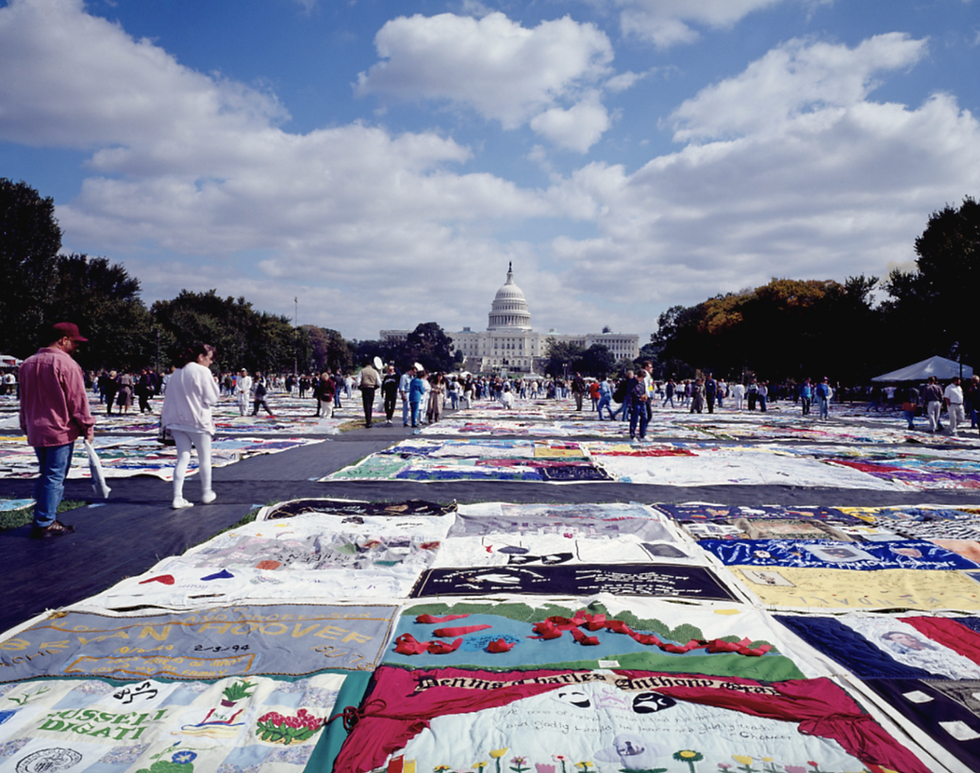
The largest community art project ever created was the AIDS Quilt.
The quilt was conceived of in 1985 by Cleve Jones, a longtime gay-rights activist from San Francisco. Every year, Jones helped organize an annual candlelight march honoring San Francisco supervisor Harvey Milk and mayor George Mascone, who were both assassinated in 1978.
While planning the 1985 march, Jones asked participants to write the names of some of the 1000 people in the city who had died from AIDS in the past year onto cardboard signs.
These signs were then taped on the walls of the federal building, as a plea to the government to take compassionate action to curb the epidemic.
Looking at the signs, Jones recalls that “Suddenly the names looked like a patchwork quilt…and the idea evoked such warm old memories of comfort…. He continued, “I had been consumed with rage and fear. Most of my old friends were dead. I felt where we lived would be destroyed without the rest of the world even noticing. I knew we needed a memorial.”
Jones made the first three-by-six-foot panel for the quilt in 1986 for his best friend.
From cardboard to cloth, from the streets to a shared sewing studio, Jones and friends created the NAMES Project—a collective art project making thousands of 3 ft by 6ft panels.
When the compiled quilt was first displayed on the National Mall in Washington, D.C. in 1987, it covered a space larger than a football field.
To date, more than 100,000 lives have been memorialized in its panels—people like Perry Ellis, Keith Haring, and Freddie Mercury, remembered by friends, partners, and family members who refused to let their lives be reduced to statistics.
But not everyone memorialized in the quilt was a hero.
Throughout the 1980s and ’90s, prominent pastors, pundits, politicians, and activists used their power to harm LGBTQ+ people. Perhaps most painfully, some of those people were themselves gay men who remained closeted while publicly contributing to the very culture that dehumanized people like them.
One was the powerful conservative lawyer and political operative Roy Cohn.
Cohn publicly denied being gay and, even as he was dying from complications of AIDS in 1986, denied that he had the disease.
Roy Cohn’s panel in the AIDS Quilt bears just three words:
Bully. Coward. Victim.
Cohn caused harm. He participated and enriched himself in a political world that dehumanized LGBTQ+ people. And when he caught the virus himself, these choices would still not save him.
In the face of widespread homophobia and cruelty, the AIDS Memorial Quilt insisted upon the humanity of people caught in both the epidemic and the culture war surrounding it. Its sheer scale forced the nation—and the government that had failed so many—to confront the staggering human cost of indifference.
In 1989, the Quilt was even nominated for the Nobel Peace Prize.
And I think there is something profoundly faithful about that kind of witness. About stitching together the story of our collective humanity at a time of great division and cruelty.
Living out our Christian faith is hard, in the best of times.
To live with faith, hope, love, forgiveness, peace. Have you seen the world?!
Sometimes the things Jesus asks of us seem about as reasonable as asking Peter to step out of a boat and walk across the water.
How are we supposed to bridge the chasm between homophobic Christianity and affirming Christianity?
How are we supposed to repair our political divisions?
How are ordinary people supposed to enact justice when billionaires and corporations seem to possess almost limitless power?
How are we supposed to mend tears in the fabric of our communities that have been widening for generations?
Some days, these things feel impossible.
But faith isn't about accomplishing the impossible, by ourselves.
Faith is trusting that God is still accessible to us when we are faced with the impossible.
Today, we can take comfort in our faith that God is still present. Despite everything.
In the Giselle , Peter does not calm the storm.
He does not make the water solid beneath his feet.
He simply sees Jesus out there in the chaos—and takes a step toward him.
And for a moment, he walks.
Then he notices the wind. And he becomes afraid, and he begins to sink!
But then Jesus reaches out his hand.
Church, we will continue to stumble.
There will be divisions we cannot bridge. There will be injustices we cannot overcome. There will be wounds that heal only heal enough so that we can live with them. There will be moments when the wind howls, when our courage fails, and when the impossible remains impossible.
But we can still step out of the boat.
We can still take one step toward justice.
That one step toward reconciliation.
That one step toward the neighbor we have been taught to fear.
We can make that one stitch toward repairing what has been torn.
And when we lose our courage—and we will—we can reach again for the hand of Christ.
Because faith does not require us to believe that we can fix everything. Faith asks us to trust that even here, even now, even in the storm, Christ is still reaching for us.
Thanks be to God.
Sermon preached by Rev. Delaney Piper on 8/9/26.


Comments